Our recovery solutions
Livestock and poultry manure
Livestock and poultry manure is traditionally applied on agricultural land as fertilizer. While this practice allows for the reuse of manure nutrients and reduces the demand for chemical fertilizers, this practice is not environmentally sustainable. The nutrient content in the manure is not balanced and its land application inevitably leads to excessive nutrient loads, particularly phosphorus. This creates significant environment pollution problems since the excess nutrients are leaching into the ground water and contaminate lakes and rivers. It often results in eutrophication and algae blooms that deplete the water of oxygen and kill many species of aquatic life.
PHOSMAG Solution
PHOSMAG offers a sustainable waste management solution for resource recovery from agricultural waste. It integrates innovative technologies in order to extract valuable resources from manure. Anaerobic digestion process for energy recovery in the form of biogas is combined with our state-of-the-art proprietary nutrient recovery technology MINEPHOS that selectively extracts high quality struvite fertilizer as well as organic biosolids suitable for land application.
MINEPHOS was successfully validated at commercial scale for treatment of anaerobically digested chicken manure as well as pig manure. It is capable of producing a high-quality granular struvite product PHOSTONE™ with high phosphorus content and high market value. Struvite is a slow-release fertilizer, so its use does not result in the nutrient loss with runoffs and associated water pollution. Instead, the nutrients remain in the soil and provide long term nutrition for the crops. The residual biosolids after phosphorus extraction contain organic matter and other nutrients, have low moisture content and no pathogens, and can be safely used as organic fertilizer or soil amendment. Having these commodities extracted from the manure and reused reduces agricultural reliance on synthetically produced fertilizers and promotes the use of environmentally sustainable alternatives. Finally, the residual liquid after extracting the resources from manure can also be safely used for irrigation.
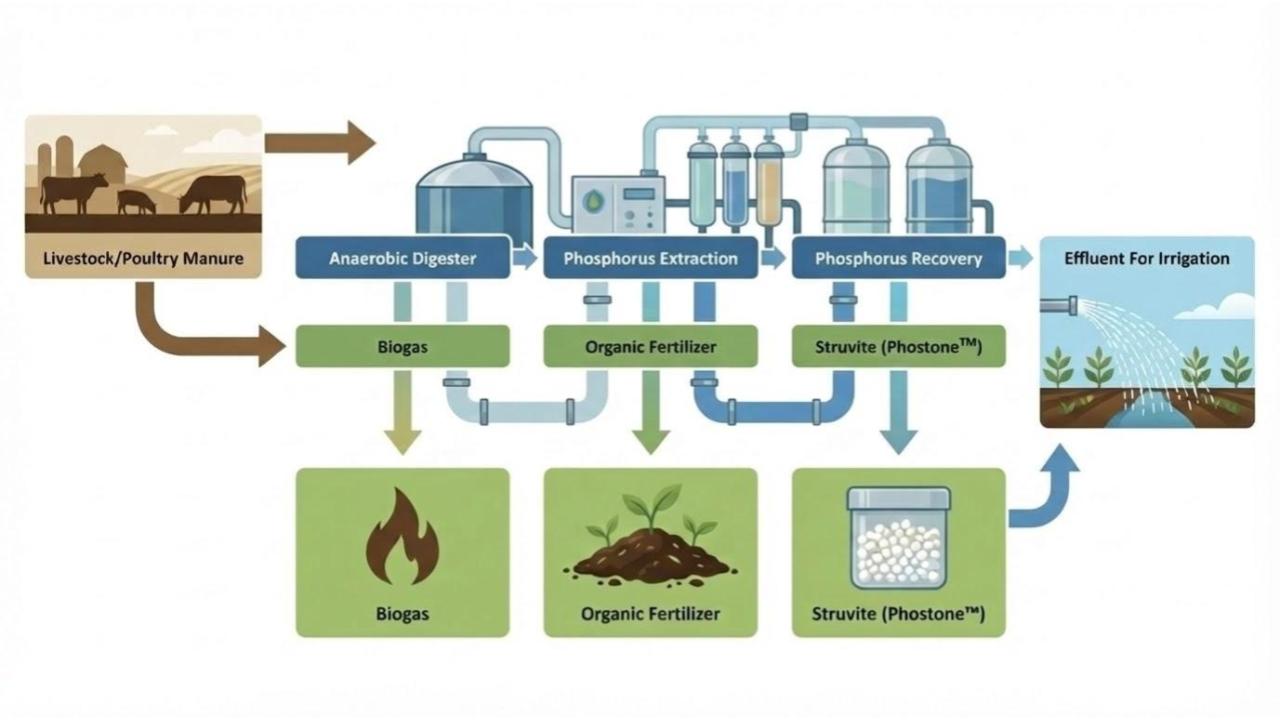
The main benefits of our manure management and resource recovery solution include:
- When combined with anaerobic digestion, energy recovery and reduction of organic waste
- Over 90% combined phosphorus recovery from manure as struvite and organic fertilizer
- Recovery of value-added fertilizer products with balanced nutrient content
- Reduced reliance on synthetic fertilizers through sustainable reuse of resources
- Reducing excessive land application of manure and mitigating environmental pollution of water bodies
- Reduction in greenhouse gas emissions resulting from fertilizer and manure application
Sewage sludge
Sewage sludge contains nearly all of the phosphorus that originally enters municipal wastewater treatment plants with the raw sewage. Many sewage treatment facilities across the world use anaerobic digestion to stabilize the sludge, reduce its volume, and recover biogas. During the process, nutrients such as phosphorus and ammonia nitrogen are often released from the sludge and contribute to uncontrolled formation of struvite. The buildup of struvite deposits in pipes and equipment requires costly maintenance. In addition, phosphorus-rich liquid after sludge dewatering is often returned to the headworks of the plant which creates an increased nutrient load on the mainstream process and often results in failure of the sewage treatment plant to meet the regulatory nutrient discharge limits, as well as increased costs of nutrient removal during the mainstream process.
PHOSMAG offers flexible solutions for phosphorus recovery from sewage sludge:
Recovery from sludge dewatering liquid:
- • Struvite recovery only from dewatering liquid of anaerobically digested sewage sludge (centrate, AD supernatant)
- • Simple and low-cost solution to reduce phosphorus load from the liquid
- • Reduction of operational and maintenance costs due to struvite buildup in pipework
- • Easy retrofit and minimal interference with mainstream process
Recovery from the entire sludge:
- • Pre-treatment of sewage sludge to release up to 70% of total phosphorus
- • The process uses chemical acidification to selectively extract phosphorus from the sludge while keeping unwanted impurities separated (e.g. heavy metals)
- • Maximized phosphorus recovery and 5-10-fold increase in struvite production
- • Improved residual sludge stabilization and dewatering
Benefits of struvite recovery for sewage treatment plants with sludge anaerobic digestion:
- Reduction of phosphorus load to the mainstream process by 10-15% through phosphorus removal from the sidestream dewatering liquid
- Over 90% removal of phosphorus from the dewatering liquid
- Reduction of operation and maintenance costs from elimination of struvite deposits in pipes and equipment of the sidestream process
- Over 20% reduction of chemical consumption of coagulants such as PAC or ferric salts for chemical phosphorus removal
- Significant reduction in production of chemical sludge (up to 90%)
- Improved dewaterability of anaerobically digested sludge by 4%
- Resource recovery from waste and additional revenue from recovered value-added product
- Positive environmental impact through reduction of nutrient pollution from sewage discharge
- Meeting regulatory discharge limits for pollutants
Industrial wastewater
MINEPHOS is capable of treating a wide variety of industrial wastewater often deemed too challenging for other phosphorus removal and recovery technologies to treat. There is no upper limit for phosphorus content in the waste and high phosphate concentrations are preferred.
The following types of wastewaters can be treated:
- Phosphate mining wastewater and phosphogypsum leachate
- Food processing wastewater
- Pharmaceutical wastewater
- Other wastewater streams with high content of phosphate
The treatment efficiency is considered on a case-by-case basis and depends on the level of pretreatment required to remove contaminants such as heavy metals, fluoride, some organic matter, suspended solids over 2%, and ability to solubilize phosphorus.